A golden retriever started ‘running’ ads for Booking.com. A man turned the exact forehead people bullied him for, into rentable ad space. Domino’s discovered that potholes were wrecking their pizzas mid-delivery, and they fixed the road instead of the drivers’ route.
None of these are unusual problems. They’re the most ordinary kind (a bored pet owner, unimaginative mockery by internet trolls, and failed service delivery). The provocative part is that they were solved with powerful, lateral thinking.
We tend to think creative breakthroughs need something extraordinary to work with, like a strange brief, a rare client, or a problem nobody’s seen before. They don’t. The organisations that consistently produce meaningful ideas are the ones that have built an innovation environment where non-obvious connections are protected and nourished.
Here’s what that actually looks like in practice.
Borrow Where No One’s Looking And Glance Sideways
Innovation researcher Steven Johnson spent years studying where breakthrough ideas actually come from, and his answer wasn’t genius or isolation: it was proximity. As he put it in a 2010 TED Talk, Where Good Ideas Come From: “Chance favours the connected mind.”
Ideas don’t arrive from nowhere; they arrive at the intersection of things that already exist, recombined in a way nobody has yet tried. This is what Johnson calls the “adjacent possible”.
A quick aside…
Creativity is a byproduct of curiosity. That’s why at Flume, we have embraced the habit of looking sideways (at glass blowing, dog grooming, bonsai pruning, or figure skating, at whatever a completely unrelated industry is doing). It’s how this “adjacent possible” actually gets found. You can’t always control when inspiration strikes, but you can cultivate the conditions for it.
Key takeaway: Don’t wait for inspiration to strike, it’s likely they won’t. Instead source and save ideas from: Pinterest. Your favourite cooking show. Your evening run. Spotify’s “Discover Weekly”. Award-winning case studies. Comment sections. Your coffee’s foam. Dieline. Cosmos. Behance. Spyglass. ‘Outfit of the day’ videos.
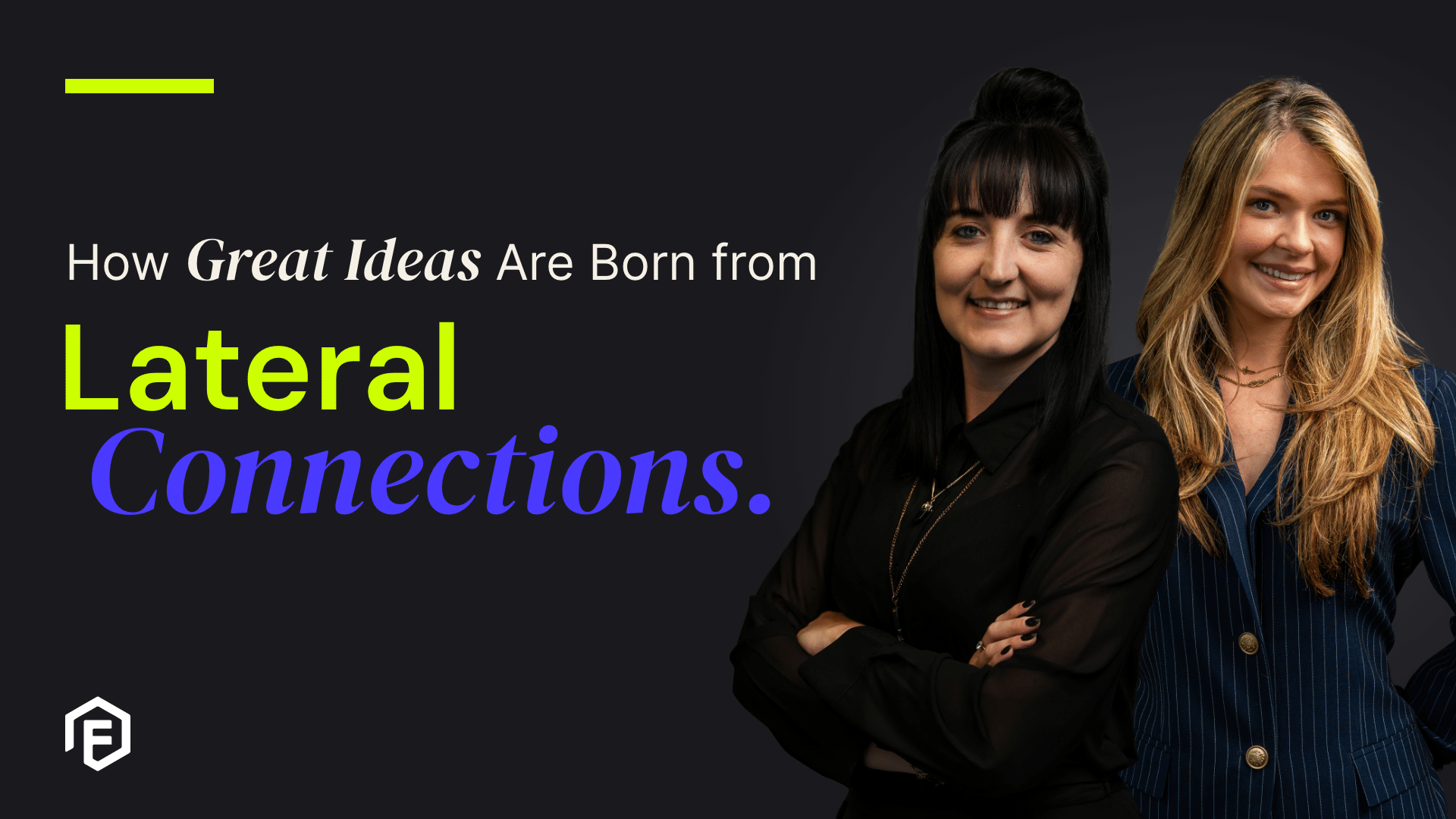
How Great Ideas Are Actually Formed And Where They Come From
Part one: Let the room decide, not the sole ‘genius’
History is littered with tales of the solitary mind. Unsurprisingly then, if you ask most people where do great ideas come from, they’ll likely point to a single genius in a room.
Yet if you look closely at almost any real breakthrough, you’ll usually find a team, a network, or a series of half-formed ideas passed between people before anything resembles a “big idea”.
The actual origin of innovation is rarely one person’s spark; it’s the back-and-forth nobody thinks to credit. This matters practically because it changes how a team should actually work.
If ideas come from one brilliant person in a room, the job is supporting that person. If ideas come from synthesis across many perspectives, the job is to build the conditions where collaboration can happen.
Our recommendation: psychological safety is non-negotiable. People don’t offer their half-formed, possibly-bad ideas in a room where those ideas get punished or unduly critiqued. Keep that in mind during these early stage ideation sessions. This philosophy will truly enrich your creative projects and problem-solving capabilities.
It’s a big part of why Flume runs on an anti-ego culture rather than a hero culture. Nobody’s chasing credit for the idea that survived the room, because we all pressure-tested the concept together.
Part two: Embrace continual inspiration, not eureka moments
Creativity is often mythologised by grand epiphanies and lightning bolts. However, if you’re looking for how to generate great ideas on demand, waiting for a flash of insight is the wrong strategy.
Real creative work seldom arrives that way. It behaves more like a “slow hunch” according to Johnson. It’s an instinct that only becomes an idea worth shipping after it’s been rewritten, argued with, and taken apart more than once.
The honest answer to how to come up with ideas is less romantic than earth-shattering moments of divine insight: it’s the creative ideation process, where the drafts and dead ends matter as much as whoever had the first spark.
Most breakthroughs are gradual, not sudden; the finished idea is just the part anyone else gets to see.
- Key takeaway: Protect early, unfinished thinking, and reward the people who hand ideas off rather than the ones who hoard them.
New Tools Strengthen the Raw Material, Not Discernment
Technology is best utilised as a sparring partner. It’s something to react against, refine, or deliberately reject on the way to a better answer. The organisations getting real value from artificial intelligence (AI) and other technology in their creative process aren’t using it to skip the thinking. They’re using it to have more of it, faster.
AI is the obvious example right now, but it’s really one wave in a much bigger shift: automation, generative design tools, predictive targeting, biometric and adaptive media, and other tools that didn’t exist even a few years ago.
- What if a billboard adjusted its message based on your facial expression or the weather?
- What if ads stopped feeling like ads at all, and started feeling like a physical place you could enter, or a system that rewrote itself when engagement dropped?
None of that is far-fetched anymore.
What doesn’t change, no matter how the tools evolve, is the human judgment call and instinct underneath them.
- Key takeaway: Treat new tools as a way to generate more raw material to argue with, not a replacement for the judgment that decides what’s actually worth shipping. And always remain ethically steadfast.
Conclusion
We’ll leave you with this… Creativity can be artful while remaining commercially viable. Done well, it’s profitable. The next time a good idea lands, it’s worth asking where it actually came from, and building more of that condition on purpose.
Be curious. Be observant. Be willing to solve the boring problem nobody else wanted.